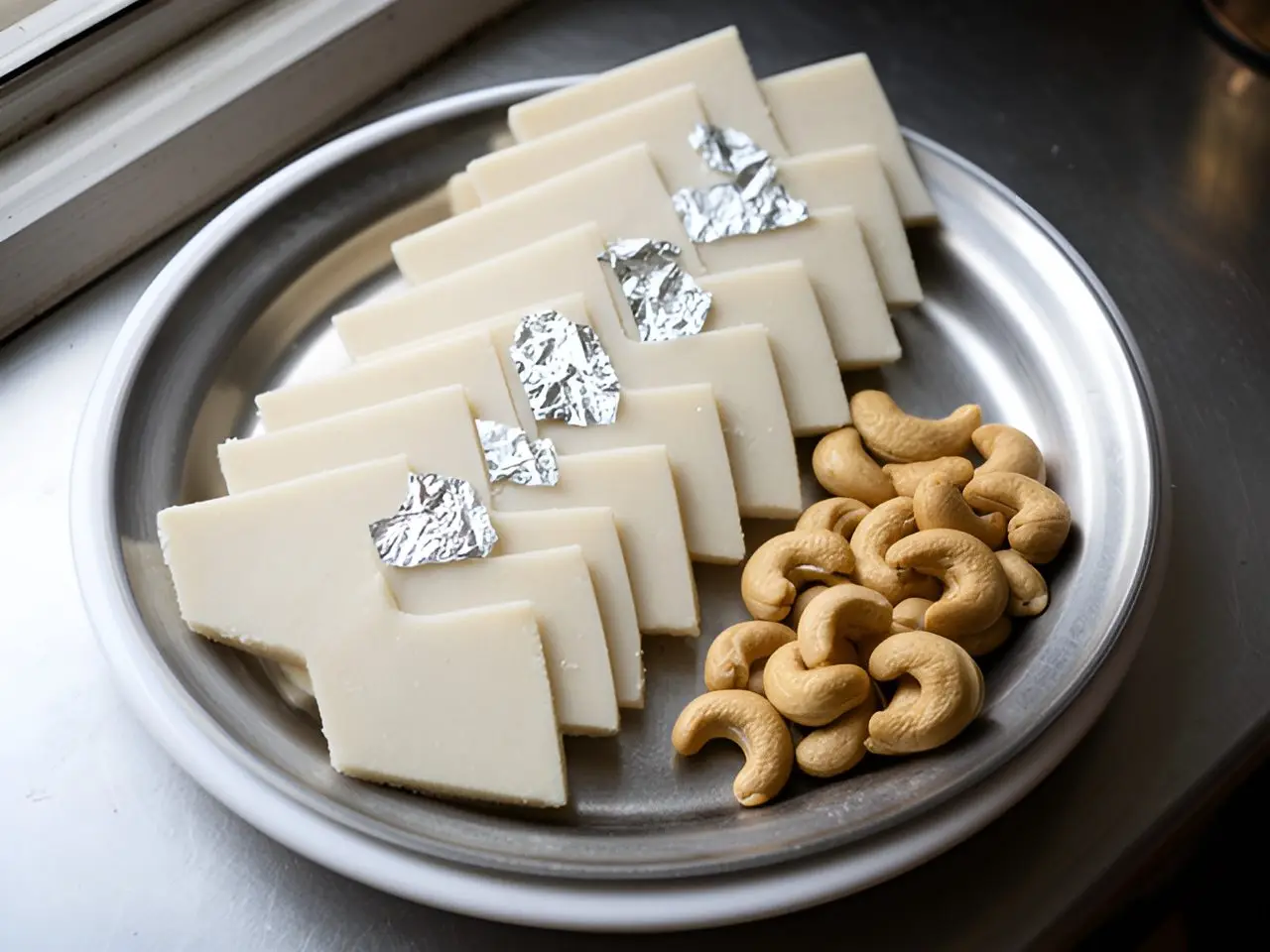
Kaju katli is the thin, silver-topped cashew sweet found in Diwali gift boxes all over India, sold by halwais in every region. At home it needs only three ingredients and ordinary kitchen kit: a mixer grinder, a non-stick pan, a rolling pin and baking paper.
Why this recipe works
- Grinding in short pulses gives a fine, dry cashew powder instead of an oily paste, so the katli is smooth rather than greasy.
- A light syrup and low heat let the cashews cook into a dough slowly, giving you time to catch the right stage.
- The soft-ball test on a cooled pinch tells you exactly when to stop, which is the difference between sticky, perfect and crumbly katli.
Method
Put the cashews in a dry mixer grinder jar and grind in 3 or 4 short pulses of 2 to 3 seconds, shaking the jar between pulses, until you have a fine powder. Stop before it clumps or looks oily. Sift through a fine sieve and regrind only the coarse bits left behind, again in short pulses.
Tip: Grinding continuously warms the cashews so they release oil and turn into cashew butter, which makes greasy, crumbly katli.
Cut two sheets of baking paper about 30 cm long and have a rolling pin ready. Put the sugar and water in a heavy non-stick pan over medium heat and stir until the sugar has completely dissolved, then let it boil without stirring for 2 minutes, until the bubbles look slightly thicker. It does not need to reach a string.
Turn the heat to low and add the cashew powder. Stir continuously, scraping the base and sides, for 6 to 9 minutes. The mixture will look like a thick, wet batter at first, then thicken, turn glossy and start to come away from the sides of the pan as one soft mass.
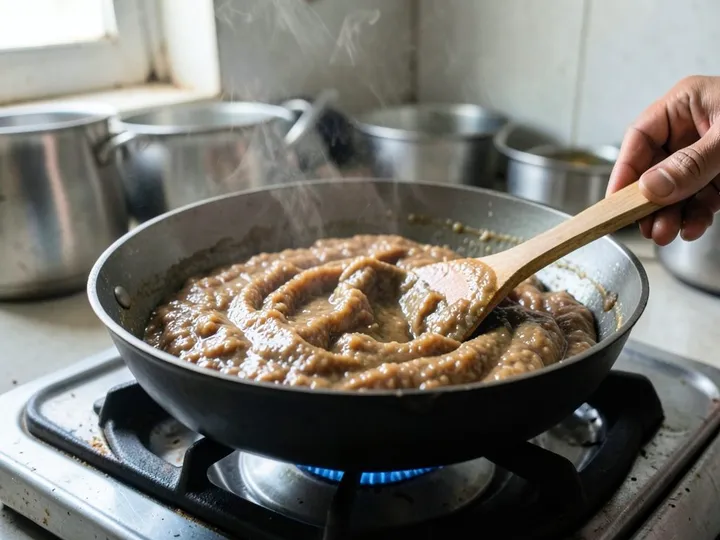
Test for the soft-ball dough stage. Pinch off a pea-sized piece, let it cool on a plate for 10 seconds, then roll it between your fingers. It is ready when it rolls into a smooth, soft ball that does not stick to your fingers. If it sticks, cook for 30 seconds more and test again. Take the pan off the heat as soon as it passes.
Tip: The mixture is hot sugar and can burn. Do not taste it from the spoon or touch it in the pan; always cool the test piece first.
Scrape the dough onto one sheet of baking paper and leave it for 2 to 3 minutes, until it is warm enough to handle but still pliable. Knead it with the heel of your hand, using the paper to fold it at first, for 1 to 2 minutes until it is completely smooth and free of cracks.
Flatten the warm dough into a disc, cover with the second sheet of baking paper, and roll it out evenly to 3 to 4 mm thick, rolling from the centre outwards.
Peel off the top sheet. While the sheet is still warm, cut it with a sharp knife into strips about 3 cm wide, then cut diagonally across them to make 3 cm diamonds. Leave to set for 30 minutes at room temperature, then separate the pieces. Makes about 30, plus a few edge pieces; that is 10 servings of 3 pieces each.
Swaps & substitutions
- Plain cashew flavour → Add 0.25 tsp cardamom powder (0.5 g): Stir it in with the cashew powder. Traditionally kaju katli is left plain to taste of the nut.
- Plain top → Edible silver leaf (varak): Lay it on the rolled sheet before cutting. Some varak is made using animal products, so check the packet if you keep this vegan.
- Water → Whole milk (60 ml): A richer, slightly creamier katli. It is no longer vegan, and keeps for 1 week in the fridge rather than 2.
Storage & reheating
Store in an airtight container in a single layer or between sheets of baking paper. Keeps 1 week at a cool room temperature (below about 25 °C) or 2 weeks in the fridge. Let refrigerated pieces stand for 10 minutes before eating. Freeze for up to 2 months, wrapped well, and thaw in the fridge.
Frequently asked questions
Why is my kaju katli sticky?
The mixture was taken off the heat before it reached the soft-ball dough stage. Return it to the pan on low heat and cook for 1 to 2 minutes more, testing every 30 seconds, until a cooled pinch rolls into a smooth ball that does not stick.
Why is my kaju katli crumbly or cracking?
It was overcooked, or the cashews were ground until oily. While the dough is still warm, sprinkle over 1 to 2 tsp of warm water and knead until smooth. If it still cracks, warm it on very low heat for 30 seconds with the water, then knead again. Next time, start testing at 6 minutes and grind in short pulses only.
Do I need a thermometer or a sugar-syrup string test?
No. The syrup only needs to boil for 2 minutes. The real test is on the cashew dough itself: a cooled pinch should roll into a smooth, non-sticky ball, which is the soft-ball stage.
Can I use cashew pieces instead of whole cashews?
Yes, if they are fresh and dry. Broken cashews are cheaper and grind the same way. Avoid roasted or salted cashews, which change the colour and taste.
Which allergens does this contain?
Cashews, a tree nut. The basic recipe has no dairy or gluten. Edible silver leaf and milk are optional additions mentioned in the swaps.
Nutrition
| Calories | 122 kcal |
|---|---|
| Protein | 3 g |
| Carbohydrates | 15 g |
| Fat | 7 g |
| Fibre | 1 g |
| Sodium | 2 mg |
More in Mughlai & Awadhi Recipes and Indian Dessert Recipes. Learn the technique: The Indian Pantry: 25 Essentials.