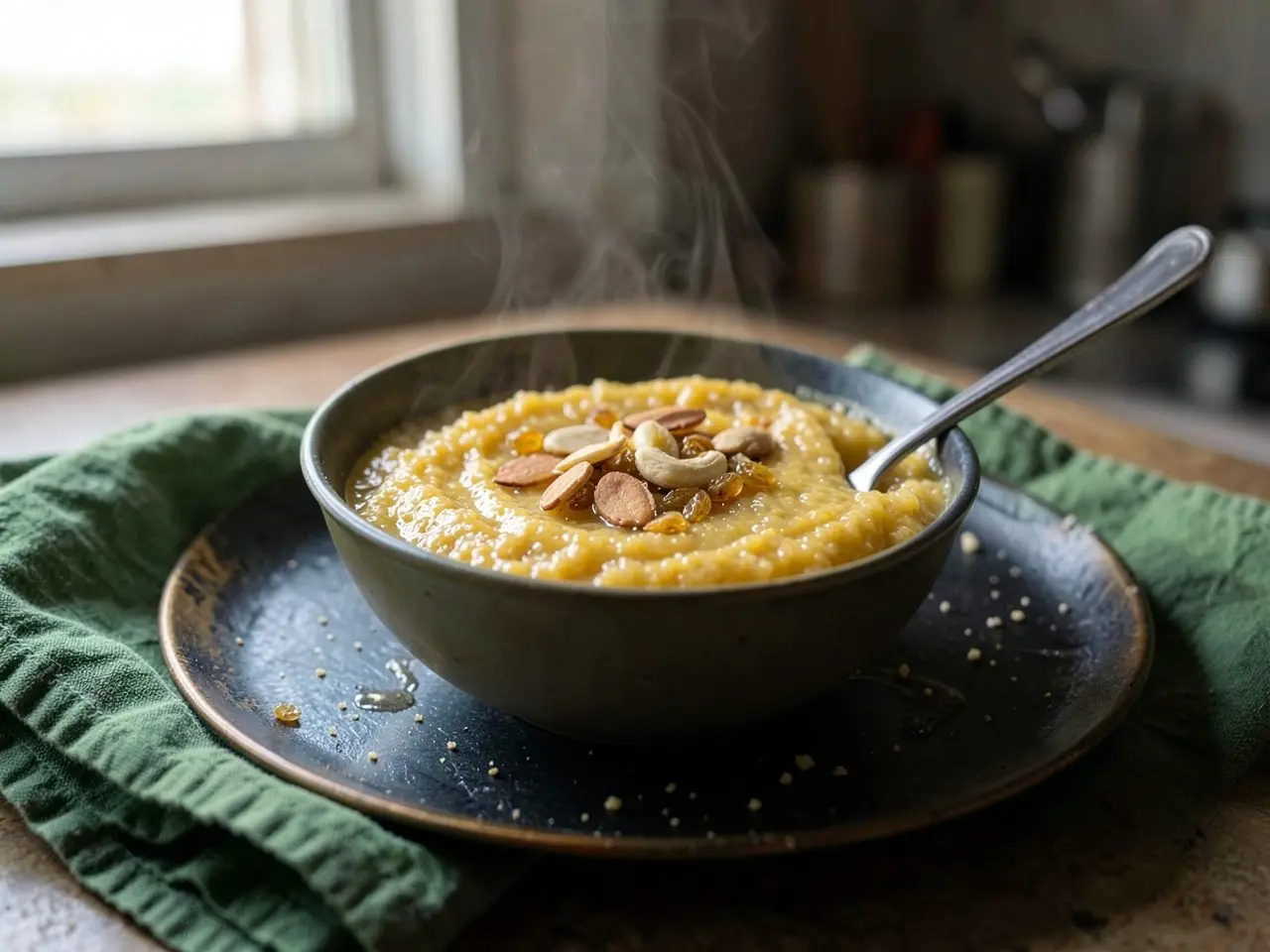
Sooji halwa, also called suji ka halwa, is the quick semolina pudding made in Punjabi homes for festivals, puja and Diwali mornings, and served as prasad. It takes about half an hour and uses pantry staples, but it turns lumpy or gluey if the roasting or the syrup is rushed.
Why this recipe works
- Roasting the sooji in ghee until golden cooks the starch and coats each grain in fat, so the halwa is soft and separate rather than sticky.
- Hot syrup poured slowly while stirring lets every grain absorb liquid evenly, which stops lumps forming.
- A fixed ratio of 1 sooji to half ghee, three-quarters sugar and 3 water gives a soft, spoonable halwa that firms up only slightly as it cools.
Method
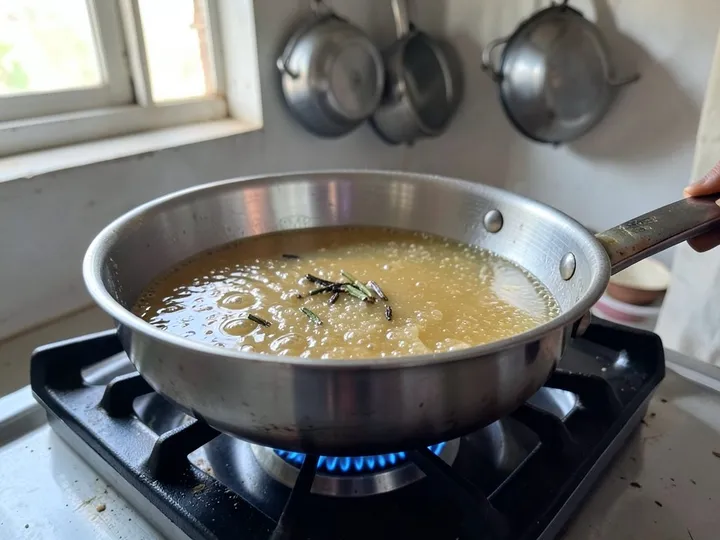
Put the water and sugar in a saucepan over medium heat and stir until the sugar dissolves. Add the cardamom, bring to a simmer and keep it just simmering on the lowest heat while you roast the sooji. The syrup must be hot when it goes in.
Melt the ghee in a heavy-bottomed kadhai or wide pan over medium-low heat. Fry the cashews and almonds for 1 to 2 minutes until light golden, add the raisins for 15 to 20 seconds until they puff, then lift everything out with a slotted spoon and set aside.
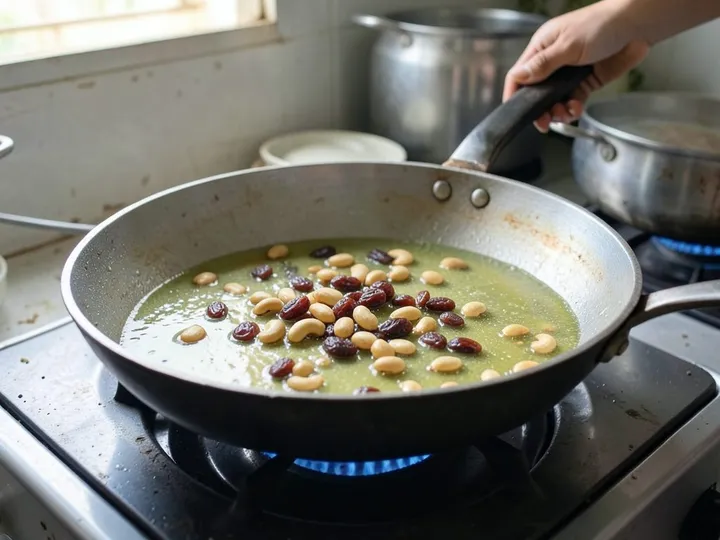
Add the sooji to the ghee and stir continuously, scraping the base, for 8 to 10 minutes. At first it looks pale and wet; it will become loose and sandy, then turn an even golden colour, like a digestive biscuit, with a toasted, nutty smell and the ghee starting to separate at the edges.
Tip: Under-roasted sooji is the main cause of sticky, gluey halwa. Keep going until the colour has clearly changed and the grains move freely.
Turn the heat to low. Stand back, and add the hot syrup a ladle at a time, stirring hard after each, keeping your face and arms clear. It will splutter and steam violently at first, so use a long-handled spoon or whisk.
Tip: Hot syrup into hot sooji, poured slowly and stirred constantly, is what prevents lumps. Cold or lukewarm water makes the starch set in clumps.
Keep stirring on low heat for 3 to 5 minutes as the sooji swells and absorbs the syrup. Break up any small lumps by pressing them against the side of the pan with the back of the spoon.
Cook for 2 to 3 minutes more, stirring, until the halwa thickens, comes away from the sides of the pan as one soft mass and the ghee glistens around the edges. It should still be soft and spoonable; it firms up as it cools.
Turn off the heat, stir in most of the fried nuts and raisins, cover and rest for 2 minutes. Serve hot or warm, topped with the remaining nuts.
Swaps & substitutions
- Water → Half water and half whole milk (360 ml each): A richer, creamier halwa. Heat the milk with the water and sugar, and keep it at a gentle simmer so it does not boil over.
- Sugar → Jaggery (150 g): Dissolve it in the hot water and strain before adding. The halwa will be brown and caramel-flavoured.
- Half a cup of ghee → A third of a cup of ghee (75 g): Lighter, but roast on slightly lower heat and stir more, since the sooji is more likely to catch.
- Cashews and almonds → Omit or use pumpkin seeds: For a nut-free halwa; the raisins and cardamom still carry the flavour.
Storage & reheating
Cool and refrigerate within 2 hours in a covered container; keeps 3 days. The halwa sets firm as it chills. Reheat in a pan over low heat with 1 to 2 tbsp of water or milk, stirring, until it is hot and soft all the way through, or microwave in 30-second bursts, stirring between them.
Frequently asked questions
What is the ratio for sooji halwa?
By cup, 1 sooji to half ghee, three-quarters sugar and 3 water. That is 170 g sooji, 110 g ghee, 150 g sugar and 720 ml water. Use 2.5 cups of water for a firmer halwa, or 2 cups for one that sets enough to cut. The 3 cups in the recipe give a soft, spoonable halwa.
Why is my sooji halwa lumpy?
The liquid was not hot, or it went in too fast without stirring. Keep the syrup simmering, pour it in a thin stream and stir hard the whole time. Press any lumps against the side of the pan with the back of the spoon while it is still loose.
Why is my halwa sticky or gluey?
The sooji was not roasted long enough, there was too much water, or too little ghee. Roast until golden and nutty with the grains moving freely, and stick to the ratio.
How do I know when the sooji is roasted?
After 8 to 10 minutes on medium-low heat it turns an even golden colour, smells toasted and nutty, feels loose and sandy as you stir, and the ghee begins to separate at the edges.
Is this the same as halwa made for puja or prasad?
Sooji halwa offered at Hindu pujas, often called sheera in Maharashtra, usually uses equal parts sooji, ghee and sugar for a richer, firmer halwa. Karah prasad served at gurdwaras is different: it is made with whole-wheat atta. This version uses less ghee and sugar for everyday eating.
Which allergens does this contain?
Wheat (sooji is durum wheat semolina), milk (ghee) and tree nuts (cashews and almonds). Leave out the nuts or use pumpkin seeds for a nut-free halwa.
Nutrition
| Calories | 384 kcal |
|---|---|
| Protein | 4 g |
| Carbohydrates | 48 g |
| Fat | 20 g |
| Fibre | 1 g |
| Sodium | 1 mg |
More in Punjabi Recipes and Indian Dessert Recipes. Learn the technique: The Indian Pantry: 25 Essentials, Indian Spices: A Practical Guide.