Tadka Across India: One Technique, Many Kitchens
Hot fat and whole spices, poured over a dish in a few seconds. Every Indian region does it, and every region does it differently. Why tempering is less a method than a regional signature.
By Nomisto KitchenUpdated First published
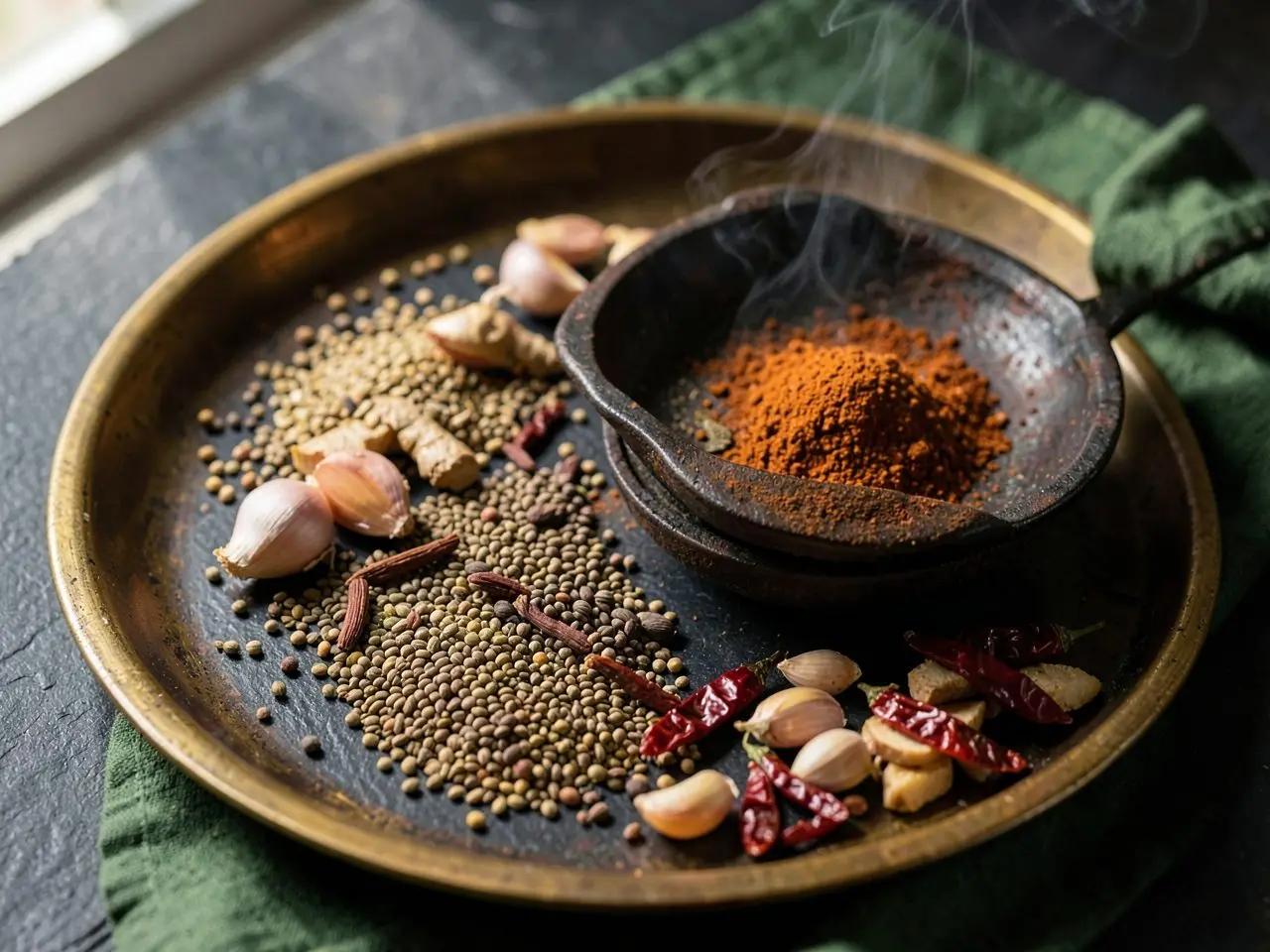
Ask cooks from five Indian states to make a plain dal and you will get five recognisably different dishes, even if the lentils, water and salt are identical. The difference is usually decided in the last half-minute, in a small pan of hot fat. Tadka, or tempering, is the closest thing Indian cooking has to a shared grammar, and yet it is spoken in a different accent in almost every region. Our argument in this essay is simple: tempering is not one technique with optional variations. It is a regional signature, and learning to read it tells you a great deal about where a dish comes from.
The method itself is covered step by step in our Indian spices guide: the order spices go in, the timings and how to stop them burning. Here we are interested in something else: why the same idea looks so different from Kolkata to Kochi.
One idea, many names
The words alone tell a story. In Hindi it is tadka or chhaunk; in Urdu and in the Hyderabadi and Lucknowi kitchens, baghar; in Marathi, phodni; in Bengali, phoron; in Tamil, thalippu; in Kannada, oggarane; in Telugu, popu. A technique that had arrived from one place, recently, would probably carry one name with it. A technique with a dozen everyday names, each rooted in its own language, looks much more like something that grew up independently in many kitchens over a very long time.
What all of them share is the principle. Many of the aromatic compounds in spices dissolve in fat far better than in water, so a few seconds in hot ghee or oil carry their flavour through a whole pot. Beyond that principle, almost everything changes: the fat, the spices, the moment it happens, and even whether it is the first step of a dish or the last.
The fat comes first
If you want to guess where a tadka comes from, start with the fat, because historically it followed what each region grew and kept.
In Punjab and much of the north, ghee is the classic medium, a natural fit for a region with a strong dairy tradition. A ghee tadka of cumin, garlic, dried red chilli and sometimes onion, poured sizzling over a pot of lentils, is the signature of the dhaba dal. Our dal tadka is built exactly this way, with the tempering as the finishing flourish rather than the starting point.
In Bengal, Odisha and Bihar, mustard oil dominates. Cooks there usually heat it until it just begins to smoke, then let it settle, which softens its raw pungency while keeping its sharp, nose-clearing character. The spices that go into it are chosen to stand up to that strength.
Along the Kerala coast, coconut oil is the everyday fat, and it gives South Indian tempering a gentle, rounded sweetness. In Tamil Nadu, sesame oil (nallennai, or gingelly oil) has a long place in the kitchen. In Gujarat and Maharashtra, groundnut oil became the household standard, a reminder that tempering, like everything else in Indian food, has kept changing: the peanut is a New World crop that reached India only after the sixteenth century.
Five seeds and a pinch of resin
The spices tell the next part of the story.
Bengal’s best-known contribution is panch phoron, a mix of five whole seeds, usually cumin, fennel, nigella, fenugreek and mustard (some cooks use radhuni, a wild celery seed, in place of mustard). It goes into hot mustard oil whole and unground, and the effect is layered and slightly bitter-sweet, quite unlike a northern tempering.
In the south, the classic tadka is a little construction project. Mustard seeds go in first and pop, then split urad dal and chana dal fry until golden and crunchy, then dried red chillies and a handful of fresh curry leaves hit the oil. Lentils used as a spice, for texture as much as flavour, are one of South India’s most distinctive ideas. You can taste it in our rava upma, where the crunch of fried chana and urad dal runs through every spoonful of soft semolina.
Maharashtra’s phodni sits between north and south: mustard seeds, cumin, a pinch of hing, turmeric and curry leaves, the foundation of kanda poha and countless everyday vegetables. Gujarati kitchens often add cloves, cinnamon or a dried chilli to a mustard and cumin tempering for their sweet-and-sour dal and kadhi.
Then there is asafoetida, or hing, the dried resin that appears in tempering across the country. It is worth pausing on, because it shows how much trade shaped “traditional” cooking. The plant grows wild in Iran and Afghanistan, not India, and for centuries the country’s supply has been largely imported. Yet hing is so central to vegetarian cooking, especially in households that avoid onion and garlic, that many people would assume it is native.
Older and newer layers
Some of what feels most traditional is relatively recent. Chillies, now inseparable from almost every tempering in the country, came from the Americas and were brought to India by Portuguese traders in the sixteenth century. Before them, heat in Indian cooking came largely from black pepper, long pepper and mustard. Every dried red chilli that blackens in a tadka today is the result of a few hundred years of adoption, fast enough to feel ancient.
Curry leaves are the opposite case. The tree is native to the Indian subcontinent, and its leaves have been part of southern cooking for a very long time. When a cook in Mangaluru or Madurai drops a sprig into hot oil, they are using one of the oldest local aromatics in the kitchen, alongside a chilli that crossed an ocean to get there.
Beginning, middle or end
The other big difference is timing, and it changes the whole character of a dish.
In much of the north, the tadka is often the finale. The dal is cooked plain and soft, and the tempering is poured over at the table, still hissing, so the aroma hits you before the first spoonful. Our chole and jeera rice show the other northern habit, where cumin seeds bloom in hot fat at the very start and everything else is cooked on top of them.
In the south, the tadka frequently comes first and sets the stage: upma, poha and lemon rice are all cooked inside the tempering. Sambar and rasam often get a second, smaller tempering at the end. In Hyderabadi cooking, baghar can happen at either end, and in dishes such as baghara rice the tempered spices flavour the rice from its first moments in the pot.
None of this is a rule. Families move, marry across regions and borrow freely, and a Tamil household in Delhi may well pour a northern ghee tadka over a southern dal. But the patterns are real enough that an experienced eater can usually place a dish within a region or two, just from the first breath of its tempering.
Why it matters at home
It would be easy to treat tadka as a single step to tick off, the way many recipe cards do: “temper the spices, then add the onions.” We think that loses something. When you cook a Bengali dal with mustard oil and panch phoron, a Kerala thoran with coconut oil and curry leaves, or a Punjabi dal with ghee and garlic, you are not choosing between better and worse versions of one method. You are choosing a region, and with it a whole set of tastes shaped by local crops, trade routes and history.
That is also the practical lesson. If a dish tastes “almost right” but not quite like the one you remember, look first at the tadka: the fat, the seeds and the moment they meet the pot. Change those and the dish usually changes more than any amount of extra spice in the masala would.
For the method itself, from heat and order to timing and what to do if the seeds burn, use our Indian spices guide. Then cook the same dal twice with two different regional tempers and taste the difference side by side.